Tel: +86 139 0589 5606
E-mail:info@globri.com

Tel: +86 139 0589 5606
E-mail:info@globri.com
Emergency exit signs are indispensable components of emergency response systems. Their core function is to clearly mark stairwells and emergency exits both day and night once an accident occurs, enabling occupants to evacuate hazardous areas rapidly. There are two mainstream types of emergency exit signs that maintain clear visibility around the clock: electrically powered standalone emergency exit signs, and photoluminescent self-luminous emergency exit signs.
With over 30 years of intensive engagement in self-luminous material R&D and production, Zhejiang Globright Optics has independently developed photoluminescent emergency exit signs that remain highly visible day and night and glow autonomously for more than 10 hours after dark, winning consistent praise from customers. As a professional manufacturer of photoluminescent exit signs, we conduct an in-depth analysis of the pros and cons of various products from an industrial perspective.
Many low-quality generic exit signs are fabricated with ordinary photoluminescent film, featuring falsely labeled afterglow duration. Moreover, they are made of combustible materials that fail to meet flame retardancy standards, which often confuses purchasers. Other prevalent issues include scattered light from LED beads, substandard batteries, non-fireproof casings, poor resistance to extreme temperatures, blurry printed markings, low visibility in thick smoke, and failure to pass random fire safety inspections.
This is the most widely adopted product on the market with notable strengths: simple wiring layout, malfunction of a single unit will not affect the whole system, and convenient renovation and installation.
However, its drawbacks are equally prominent. The built-in batteries only last 2 to 3 years before requiring replacement, and frequent maintenance and inspections are mandatory due to high failure rates. In addition, the batteries carry risks of bulging and spontaneous combustion, and electronic components are prone to damage under high-temperature conditions, leading to exorbitant long-term operation and maintenance costs.
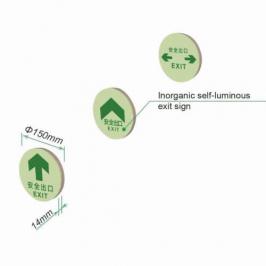
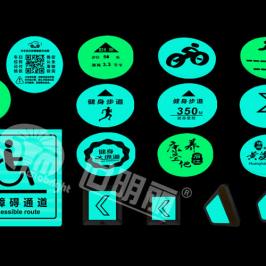
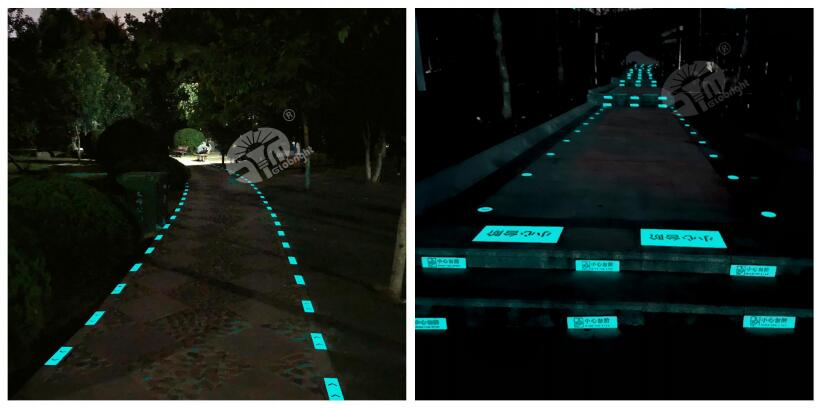
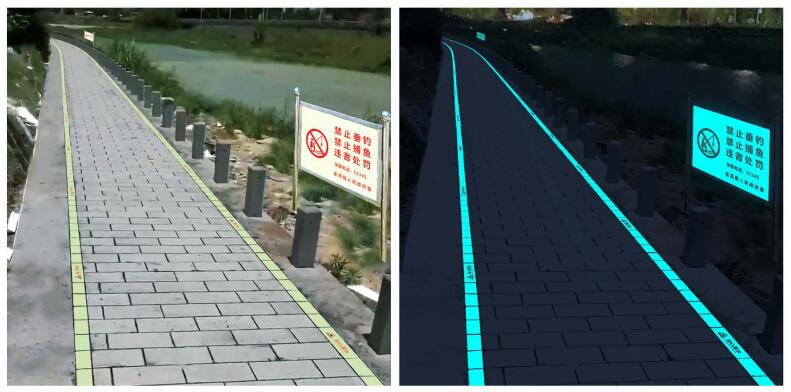
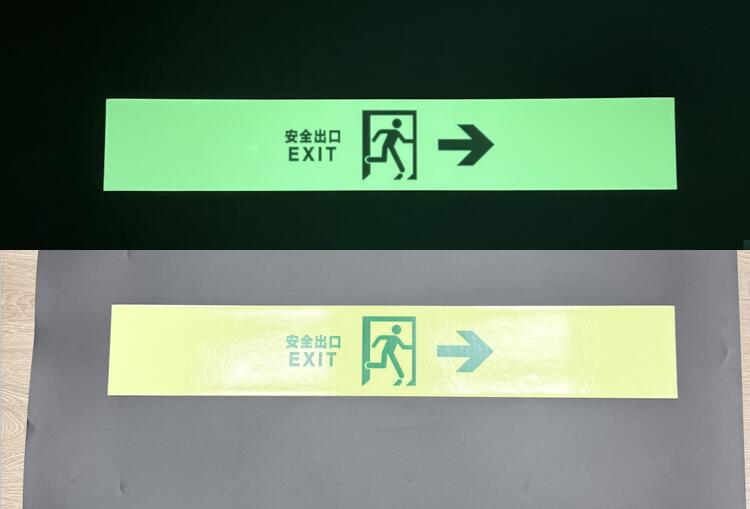
This category is divided into inorganic self-luminous signs and organic self-luminous signs. Neither type requires external electricity; they absorb natural light or visible ambient light and emit light independently in dark environments to deliver continuous directional guidance with zero post-installation maintenance. Their only limitation is that light absorption under visible light is a prerequisite for luminescence.
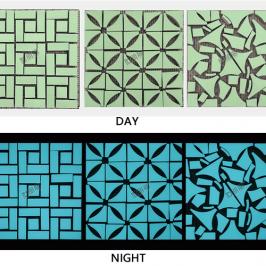
Manufactured as stone panels sintered at over 1000°C from multiple inorganic minerals, the patterns, text and color coatings are integrated into the substrate during high-temperature firing.
These products boast high hardness, scratch and abrasion resistance, tolerance to extreme high and low temperatures, non-combustibility, corrosion resistance, anti-aging performance, fade-proof graphics and markings, and immunity to water immersion. Higher ambient temperature even boosts their luminous brightness.
They deliver stable optical performance and high luminance, sustaining autonomous glow for more than 10 hours after full light storage. They function reliably during power outages or fire-induced blackouts, and provide route references for fire search and rescue operations. Barring man-made damage, the service life exceeds 15 years.
They fall into two subcategories: organic resin self-luminous coils and ordinary photoluminescent film (fluorescent / light-storing film), whose material differences lead to distinct product performance.
Signs made from organic self-luminous coils: Long afterglow duration of over 10 hours per single light charging cycle. The material reaches Class B1 flame retardant grade. It is wear-resistant, resistant to wiping with common cleaning agents, eco-friendly, non-toxic, odorless and radiation-free. The service life is over 5 years for floor-mounted installation and more than 8 years for wall-mounted vertical installation.
Signs made from conventional photoluminescent film: Only glow for approximately 1 hour, with barely perceptible luminescence after 2 hours. The material is combustible; molten drips produced during combustion may trigger secondary fire hazards.