Tel: +86 139 0589 5606
E-mail:info@globri.com

Tel: +86 139 0589 5606
E-mail:info@globri.com
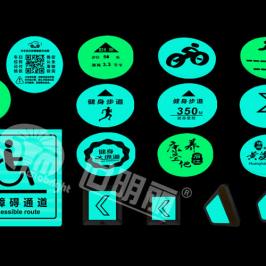
Self-luminous materials are mainly divided into two major categories: inorganic self-luminous materials and organic self-luminous materials. Based on different carrier substrates, organic self-luminous materials are further classified into organic self-luminous coils, luminous film / light-storing film and self-luminous acrylic panels. Differences in material composition and carrier substrate determine the core characteristics of self-luminous materials such as luminous duration and brightness. Both Globright inorganic self-luminous materials and organic self-luminous coils can emit light autonomously for more than 10 hours after a single light charging cycle, while the other product types only maintain a luminous duration of approximately 1 hour.
Core Manufacturing Process
Panels are sintered and fused from high-purity inorganic minerals at temperatures above 1000°C, forming a dense crystalline glaze layer on the surface.
Mechanical Properties
Mohs Hardness ≥ Grade 5; Wear Resistance ≥ Grade 3 / 1500 revolutions, capable of withstanding outdoor sand erosion and high-frequency pedestrian trampling.
Environmental Weather Resistance
Resistant to UV aging, salt spray corrosion and boiling water immersion (no cracking or peeling); completely non-combustible (Euroclass A1).
Luminous Performance
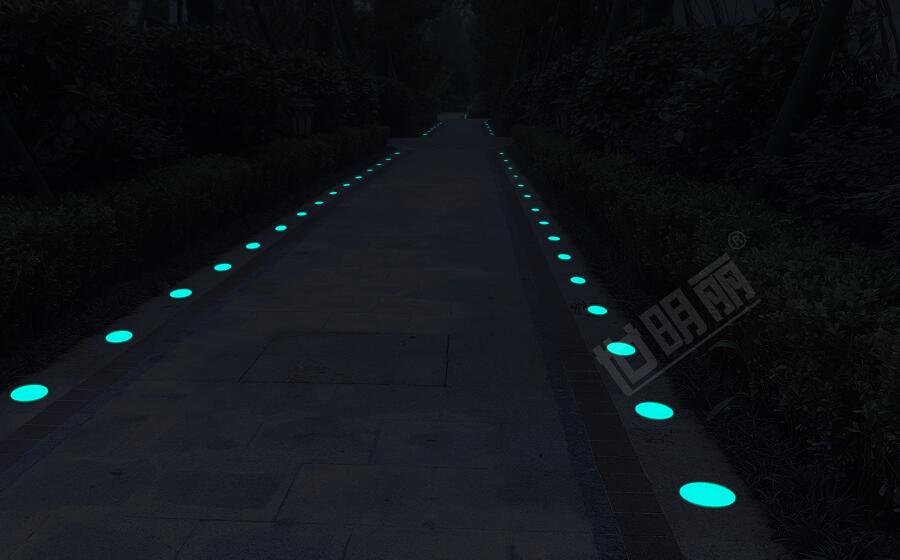
Initial afterglow brightness (2min) ≥ 5100 mcd/m²; effective luminous duration > 10 hours; afterglow intensity after 10 hours ≥ 10 mcd/m²; brightness attenuation < 5% after 15 years of outdoor service, with stable optical performance.
Safety Compliance
Heavy metal-free and non-radioactive, compliant with Class A requirements of GB 6566-2010 Limits of Radionuclides in Building Materials.
Applicable Scenarios
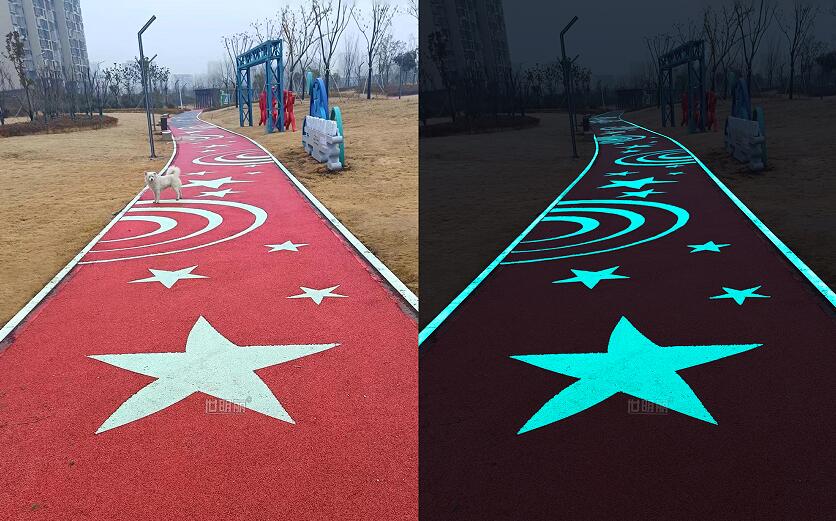
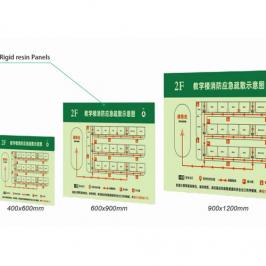
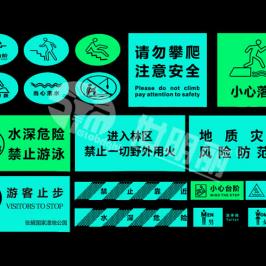
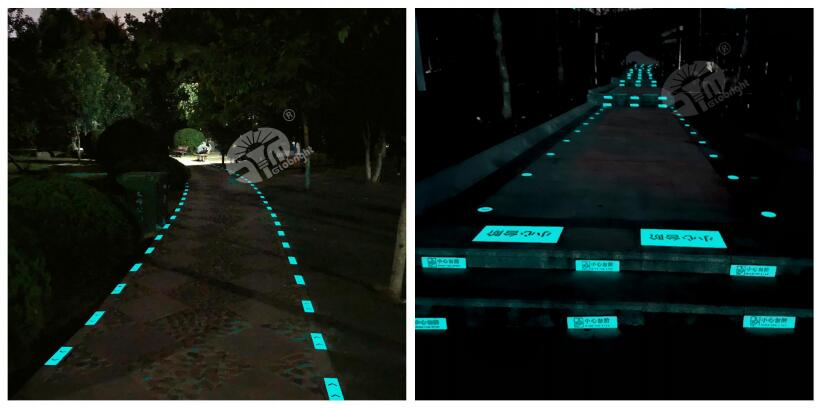
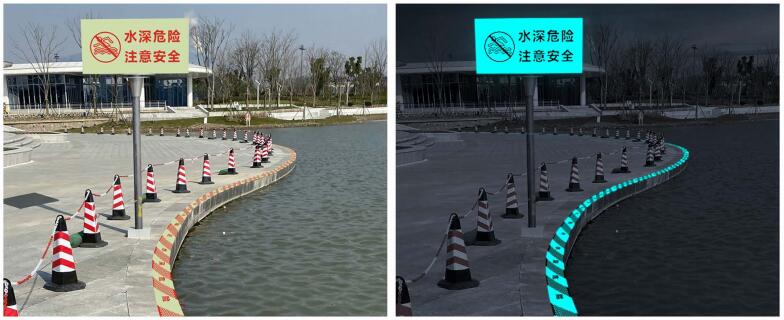
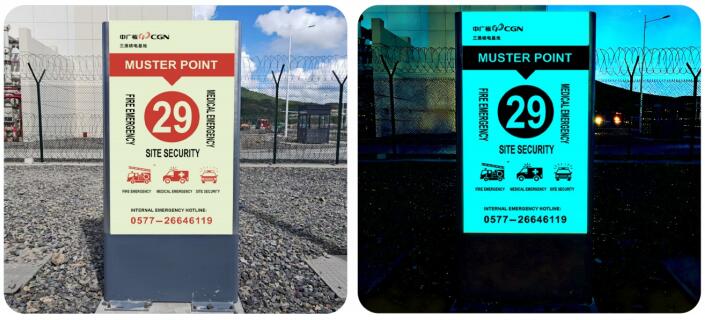
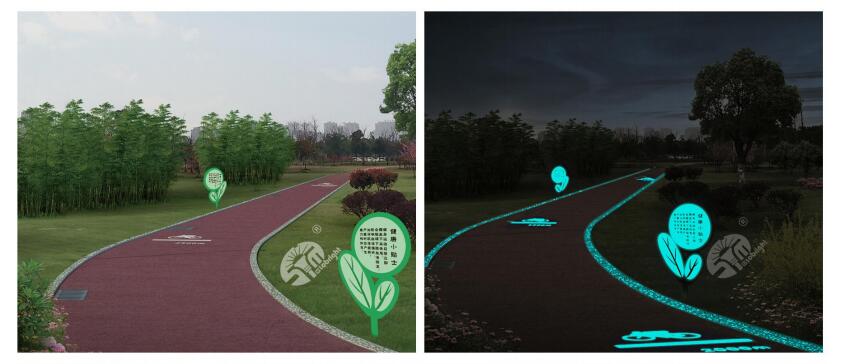
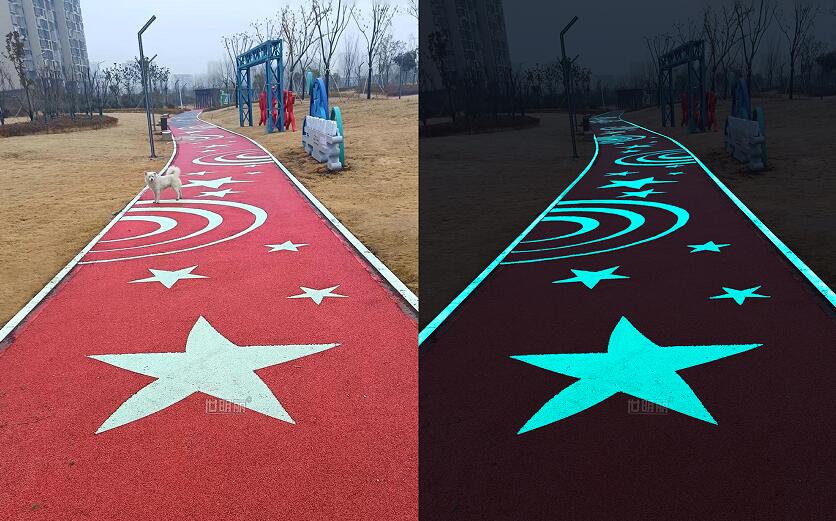
Widely used for self-luminous signs, luminous pavements and glowing roads in landscape gardens, pedestrian trails, waterfront landscapes, rural roads, fire emergency passages, underground utility tunnels, municipal roads, water conservancy projects, shopping malls, schools, hospitals, power grids and high-risk facilities. Suitable for all indoor, outdoor, floor and vertical wall mounting environments.
Core Manufacturing Process
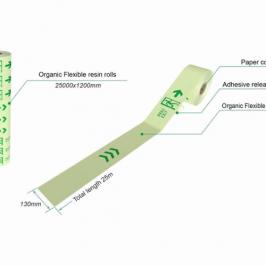
Flexible coils with a thickness of 1.50mm, made of high-molecular organic resin as the base substrate compounded with long-acting energy-storing self-luminous raw materials. The back is pre-coated with special pressure-sensitive adhesive and covered with a release liner, delivering over 10 hours of autonomous luminescence.
Flexibility & Construction Performance
Elongation at break ≥ 150%, adaptable to irregular surfaces such as cylinders, curved surfaces and internal/external corners; initial adhesive strength of backing > 20N/25mm; peel-and-stick installation, reaches trafficable strength within 24 hours with no curing period required.
Combustion Characteristics
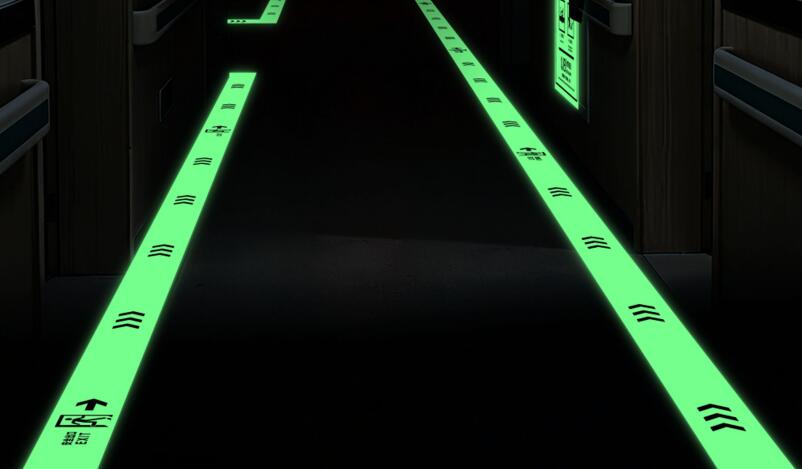
Class B1 flame retardant per GB 8624 Classification for Burning Behavior of Building Materials and Products; burns when exposed to open flame but self-extinguishes within 10 seconds after flame removal; combustion drips form carbonized crust with no flowing flame spread, suitable for fire evacuation floor stickers.
Durability
Equipped with a wear-resistant layer for floor use, with wear loss < 0.2mm after 3 years; no mechanical friction for vertical installation (walls / columns), with a service life of over 8 years.
Customization Capability
Surface compatible with UV flatbed printing, supporting customized graphics and texts.
Applicable Scenarios
Emergency guidance systems in high-traffic indoor areas — fire evacuation passages in shopping malls, warning belts along metro platform edges, luminous skirting boards in hospital wards, and irregular luminous feature walls in exhibition halls.
Core Manufacturing Process
Uses high-transparency PET (or PP) film as the carrier substrate (thickness 50–200μm), with solvent-based acrylic resin as the bonding carrier mixed with micron-sized luminous powder (particle size 15–35μm). Manufactured via micro-gravure coating, drying and curing, then laminated with release backing paper. The luminous layer thickness is controllable at 30–60μm.
Optical Performance
Effective afterglow lasts about 1 hour with relatively fast brightness attenuation, unsuitable for scenarios requiring long-duration low-light visibility.
Combustion Characteristics (Key Warning)
Both the substrate and resin are flammable organic materials. They burn continuously when exposed to open flame and produce flaming molten drips that can ignite underlying combustibles. Not recommended for fire evacuation routes or areas requiring flame retardant certification.
Advantages
Ultra-thin and flexible, easy to cut, low cost, suitable for screen printing or engraving, and convenient to install and replace with self-adhesive backing.
Applicable Scenarios
Decorative or temporary indoor signs — luminous stickers for switch panels, classification markers for warehouse shelves, and decorative star & moon stickers for children’s rooms. For spaces with low requirements for luminous duration and brightness and no mandatory flame retardant regulations.
Core Manufacturing Process
Rigid panels made of high-transparency acrylic (PMMA) matrix combined with inorganic luminous powder. First, acrylic transparent particles are accurately proportioned with modified inorganic light-storing powder and mixed at low speed in a closed environment to ensure uniform powder dispersion; second, high-temperature extrusion is performed at a constant temperature of 180–200°C to achieve deep integration of powder and acrylic molecules; finally, calendering and sizing are carried out with precision roller pressing to control panel thickness, followed by cooling and shaping.
Optics & Texture
Light transmittance ≥ 90%, presenting a semi-transparent halo effect when glowing; panel surface gloss ≥ 95 GU; suitable for laser engraving, hot bending and CNC milling processing.
Weather Resistance Limitation
PMMA has mediocre outdoor weather resistance, with noticeable yellowing after 1–2 years of outdoor exposure.
Combustion Characteristics
Identical to organic film: burns continuously with flaming molten drips when exposed to open flame, failing to meet Class B1 requirements. Strictly prohibited for use in fire compartments.
Applicable Scenarios
Indoor creative modeling and refined directional signage — floor indicator signs in hotels, luminous three-dimensional characters in shopping malls, luminous bases for display cabinets, and side luminous strips for theater steps. For decorative occasions with no open flame risk nearby and no strict requirements for luminous brightness and duration.