Tel: +86 139 0589 5606
E-mail:info@globri.com

Tel: +86 139 0589 5606
E-mail:info@globri.com
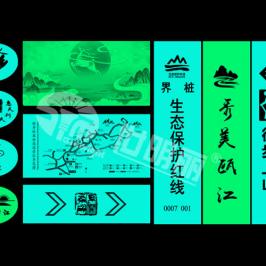
Inorganic self-luminous guidance signs and facilities are a general term. In water conservancy operation and management, they are mainly applied in scenarios requiring power-free self-luminescence, including prohibition signs for forbidden acts, warning signs for risk alerts, mandatory signs for compulsory requirements, informatory signs for information guidance, and water level gauges for hydrological monitoring.
Traditional lighting signs rely heavily on external power supply. Thunderstorms, waterlogging and line failures during flood seasons can easily cause power outages, leaving sites in total darkness at critical moments. Conventional reflective signs, static warning boards and ordinary water level gauges only function in daytime, with extremely low recognizability at night and almost complete failure. This creates a large number of safety visual blind spots at water conservancy sites, which not only easily causes patrol personnel to get lost, follow chaotic operation trajectories and stray into hazardous areas, but also leads to deviations in hydrological monitoring data, laying major hidden safety risks for flood control dispatching and emergency rescue during flood seasons.
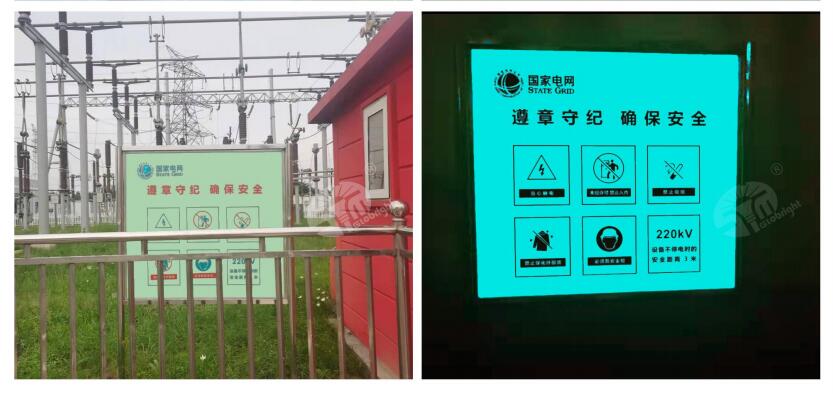
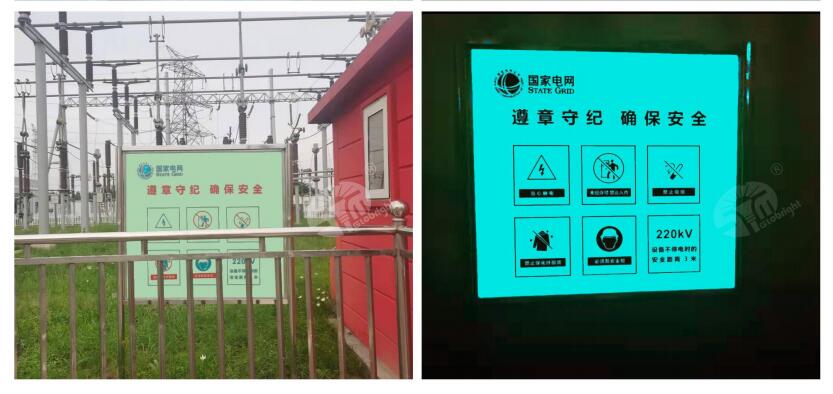
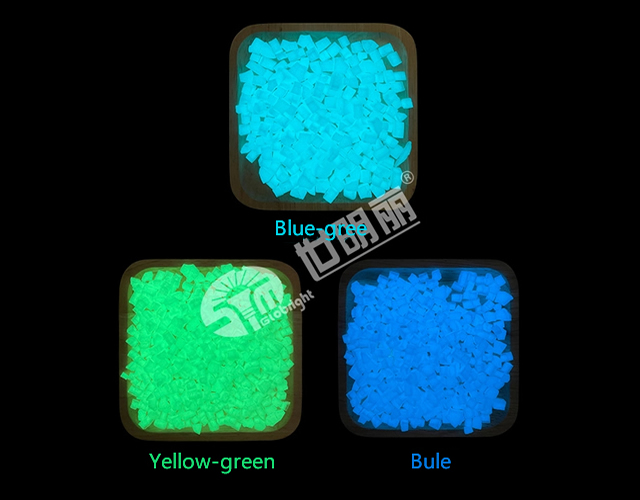
Against this background, Globright Optics, in collaboration with the Chinese Academy of Sciences, has developed inorganic self-luminous materials. The inorganic self-luminous series facilities, which require no power supply, glow autonomously for more than 10 hours at night, feature all-weather adaptability and high recognizability. They have become a key tool to address the safety shortcomings of day-and-night operation and maintenance in water conservancy and empower the refined management of smart water conservancy, fully covering all scenario demands including passage guidance, boundary standardization, risk warning, hydrological monitoring and emergency escape.
They are used to prohibit dangerous activities of personnel and vessels, mainly installed in areas such as steep waterfront banks, flood discharge outlets and closed reservoir areas. Common types in water conservancy: No swimming in the river, No fishing, No climbing over the dam, No approaching the flood discharge area, Illegal sand mining prohibited, No debris piling on floodplains.
Advantages of inorganic self-luminous prohibition signs: Prohibition signs represent the bottom line of red-line management, requiring clear and striking visibility around the clock all year round. Traditional painted and reflective prohibition signs are prone to fading after long-term sun exposure and fail at night, rendering management ineffective. Adopting the high-temperature inorganic sintering process, the markings and texts on inorganic self-luminous prohibition signs never fade or peel off permanently. They deliver striking warnings in daytime and high-brightness luminous reminders at night, preventing violations such as accidental entry into flood discharge areas and unauthorized river wading at night, and greatly improving the effectiveness of water area red-line management.
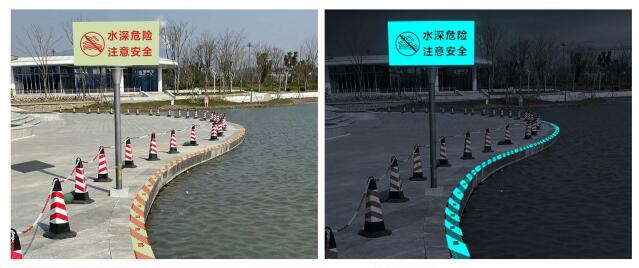
Used to indicate potential hidden dangers, they are the most widely used type of signs in water conservancy scenarios. Common types: Deep water hazard, Undercurrent underwater, Dyke landslide risk, Fall risk on steep slopes, No walking on ice surface, Flash flood prone area. They are mainly deployed at hidden risk points such as deep water camouflage sections, backflow bends and dyke slopes.
Advantages of inorganic self-luminous warning signs: Water conservancy areas are full of hidden risks such as undercurrents, steep slopes and deep water, which are also high-incidence points of accidents. Ordinary warning signs have poor nighttime visibility and lose their warning function. Inorganic self-luminous warning signs are equipped with a light-storing luminescence function, automatically delivering high-brightness warnings at night and in power outage environments, making hidden risks "visible and distinguishable". They remain clear after long-term outdoor use, serving as core configuration for long-term accident prevention at hazardous water conservancy points.
They stipulate safety actions that personnel must perform when entering the area, mostly used in sluice station platforms, construction areas and patrol wharves. Common types: Life jacket must be worn, Safety helmet must be worn, Anti-slip shoes must be worn for wading operations, Real-name registration required for reservoir entry.
Advantages of inorganic self-luminous mandatory signs: Mandatory signs are related to standardized operation and personal safety of operators. When traditional signs blister due to moisture, wear and fade, operators tend to ignore the specifications. Inorganic self-luminous mandatory signs are moisture-resistant, corrosion-resistant and scrub-resistant, remaining intact for a long time in high-humidity environments such as sluice stations and wharves. They glow automatically during night patrols and nighttime construction, always reminding operators to implement safety specifications and strengthening on-site safety management and control.
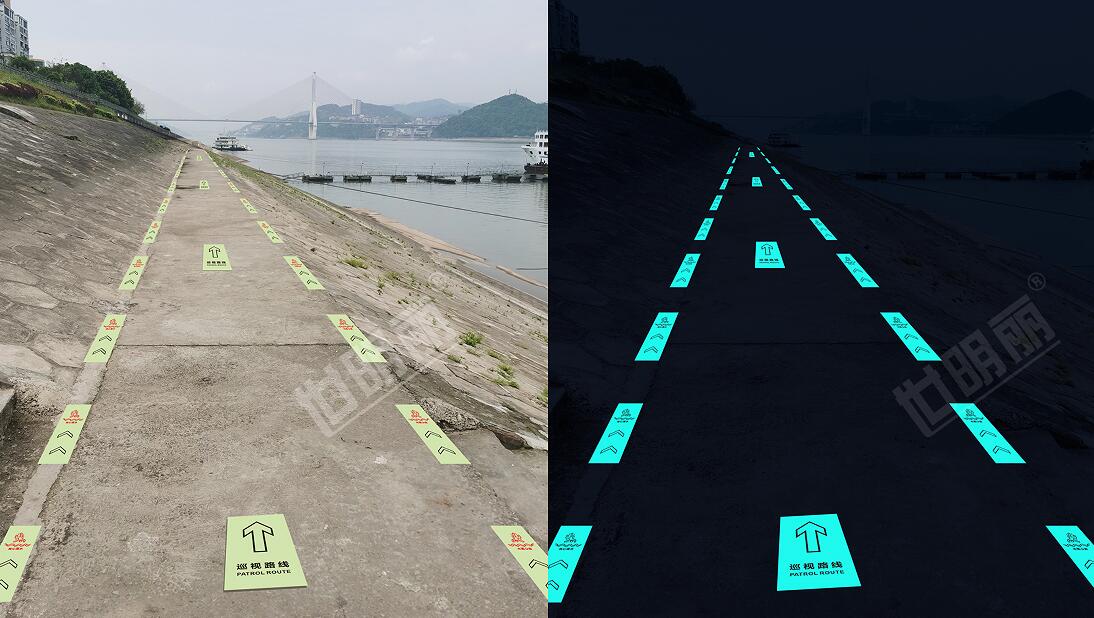
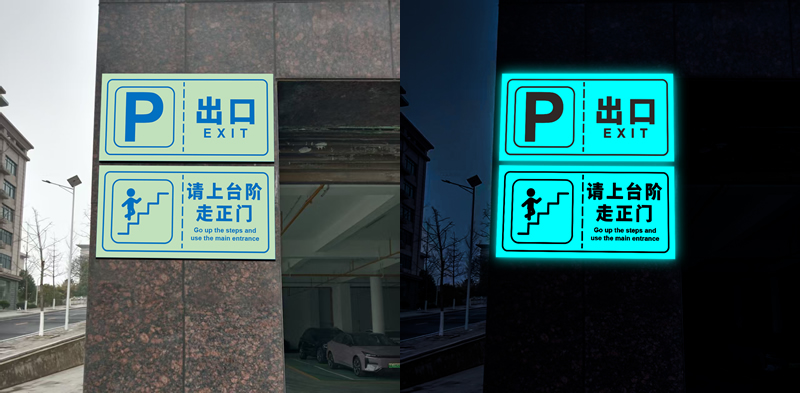
Used to indicate safety facilities, safety route boundaries, emergency passages and rescue information. Common types: Life-saving equipment storage point, Emergency assembly point, Night patrol route, Water level observation point, Emergency rescue hotline, Emergency exit.
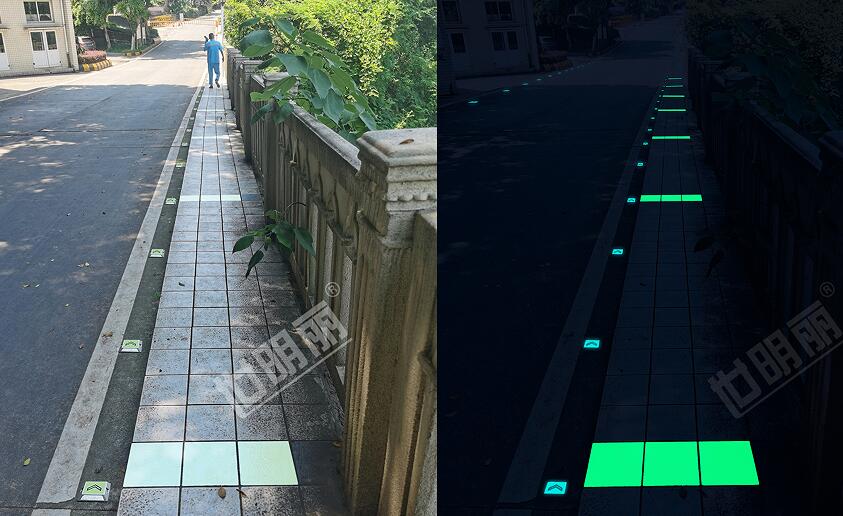
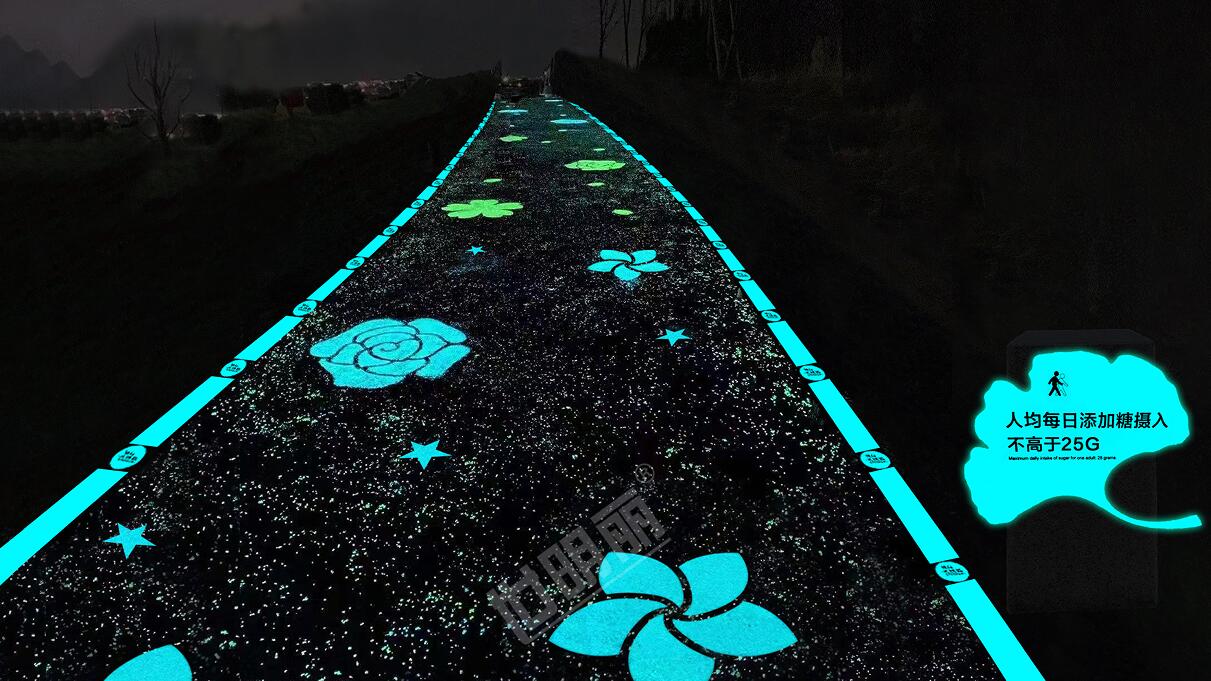
Advantages of inorganic self-luminous informatory signs: Emergency guidance signs are directly related to the success of rescue at critical moments. Ordinary notice boards are invisible in the dark at night and lose their guiding function in case of sudden emergencies at night. Inorganic self-luminous patrol routes provide guiding illumination for night patrol operations during flood seasons, with clear road contours and a strong sense of boundary. Featuring long-lasting nighttime luminescence and no power supply requirement, inorganic self-luminous informatory signs can clearly guide the location of life-saving equipment, emergency evacuation routes and rescue hotlines in case of sudden power outages and nighttime flood control scenarios, serving as a long-term guarantee configuration for emergency escape in water conservancy projects.
As exclusive measuring and marking facilities for water conservancy projects, they are used to display real-time water level data of rivers, reservoirs and sluice stations, and are the core basis for flood control dispatching, water volume judgment and hydrological observation. They are deployed across key points such as reservoir sections, river monitoring sections, upstream and downstream of sluice stations, tailings ponds and water diversion channels. Core functions: accurately reflect water level changes, support flood control decision-making, standardize hydrological data recording, and ensure safe operation of projects.
Advantages of inorganic self-luminous water level gauges: Traditional painted, film-coated and paint-filled stainless steel water level gauges generally suffer from faded graduations, blurred abrasion and poor nighttime visibility, requiring frequent replacement during long-term operation and maintenance. Adopting the inorganic mineral sintering process, the graduations and gauge body of inorganic self-luminous water level gauges are integrally fused, featuring permanent fade-proof, peel-free, scour-resistant and moss-adhesion resistant performance. They store energy in daytime and glow autonomously at night, enabling clear reading without auxiliary lighting. Compatible with night patrols and unattended video AI recognition, they realize all-weather long-term visible and maintenance-free operation of water level measurement, making them the preferred monitoring facility for the standardization of modern smart water conservancy.
To sum up, inorganic self-luminous guidance signs and facilities play an irreplaceable role in water conservancy operation and management, and are also the preferred products for the upgrading and iteration of water conservancy safety signs. Inorganic self-luminous materials fundamentally solve the problems of difficult all-weather long-term visibility, poor scenario environmental adaptability and high operation and maintenance costs, comprehensively optimizing water conservancy operation and management solutions.