Tel: +86 139 0589 5606
E-mail:info@globri.com

Tel: +86 139 0589 5606
E-mail:info@globri.com
As an original manufacturer deeply engaged in the emergency signage industry, we can state clearly that there is no uniform value for the service life of self-luminous emergency signs. It is fundamentally determined by manufacturing materials and production processes. Whether regular replacement is required shall be comprehensively judged based on material grade, application environment and functional status, and cannot be generalized.
Self-luminous emergency signs serve as the bottom-line protection facilities for fire evacuation, high-risk operations and public safety scenarios, directly related to personnel escape and operational safety under extreme conditions such as power outages, fires and nighttime conditions. From a professional perspective, Shiming Optics Technology comprehensively breaks down the actual effective service life, replacement standards and operation & maintenance schemes of emergency signs made of different materials.
Many people judge the service life of signs by "whether it is broken or fallen off", but for emergency signs, this is a typical cognitive misunderstanding.
The first type is physical service life, which refers to the duration during which the sign substrate remains intact without breakage or cracking and maintains a complete appearance. It only represents "intact appearance" and does not mean the sign is capable of emergency guidance.
The second type is effective functional service life, which refers to the duration during which the sign's luminous brightness, guidance clarity and flame retardant performance continuously meet emergency safety specifications. This is the core assessment standard for emergency scenarios. Once self-luminous brightness attenuates or fire performance degrades, the product is deemed functionally invalid even if its appearance remains intact, and can no longer undertake emergency protection functions.
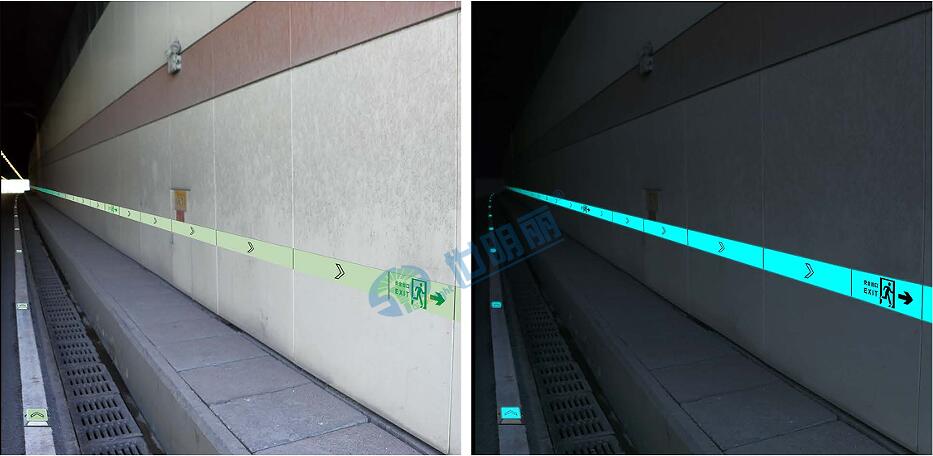
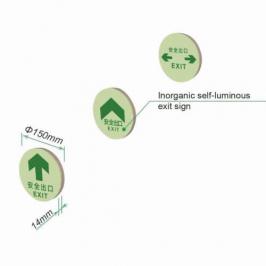
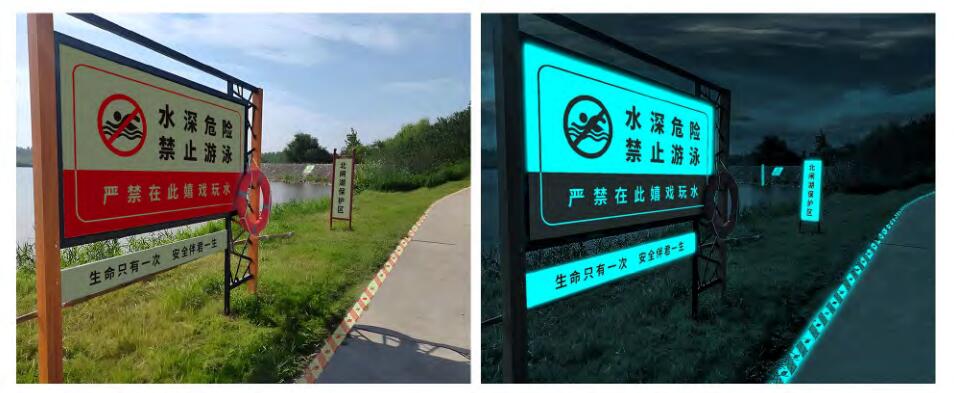
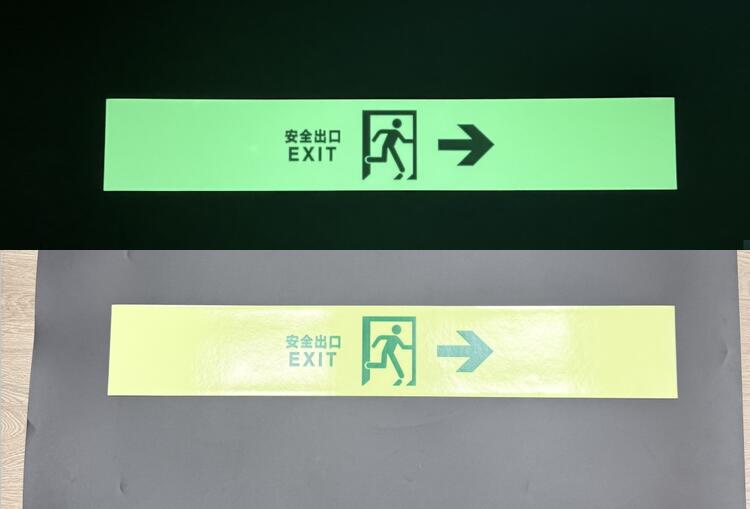
Represented by inorganic self-luminous sign panels, floor tiles and warning lines, they are the preferred material for long-term engineering projects at present.
Material & Process: Made from multiple inorganic minerals as base materials, integrally fused and formed at temperatures of over 1000°C. Graphics and colors are also sintered simultaneously. A single light charge enables autonomous luminescence for more than 10 hours.
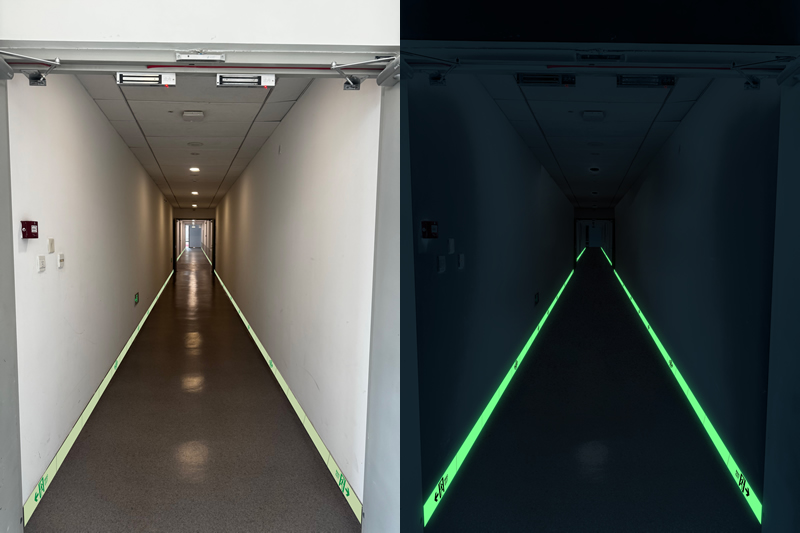
Effective Service Life: Over 15 years under open-air outdoor working conditions; matches the service life of buildings in indoor environments.
Replacement Attribute: No mandatory regular replacement required. It belongs to the "one-time installation, long-term service" product category, and only routine visual inspection is needed in daily operation.
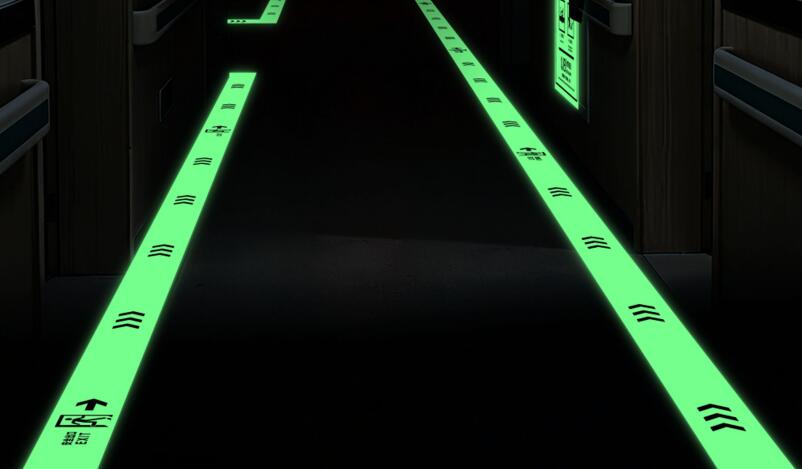
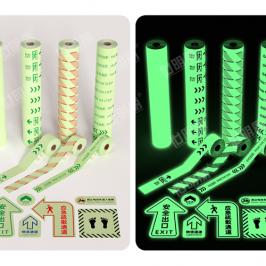
Compliant Class B1 organic self-luminous roll materials are the mainstream application material for indoor fire evacuation scenarios, balancing cost-effectiveness and compliance.
Material & Process: Flexible rolls made of new high-molecular organic resin as the base material, compounded with long-acting light-storing self-luminous materials. The surface can be equipped with a special wear-resistant protective layer. The overall product meets Class B1 flame-retardant standard, with a self-luminous duration of more than 10 hours.
Effective Service Life: Over 5 years for floor scenarios with high-frequency foot traffic; over 8 years for friction-free vertical installation scenarios such as walls and columns. Outdoor use is not recommended.
Replacement Attribute: No frequent replacement required. Only routine visual inspection is needed in daily operation, and replacement can be carried out on demand according to actual conditions.
Ordinary luminous films and light-storing films are the category with the lowest market threshold and the lowest price, and also the category with the highest incidence of emergency failure.
Material & Process: Made of ultra-thin PET plastic film as the base, mixed with light-storing powder and coated on a single surface. No wear-resistant protective layer or flame-retardant structure is included.
Effective Service Life: Only about 1 year under normal indoor environments; functional failure occurs within 3–6 months under open-air outdoor working conditions.
Failure Characteristics: Prone to adhesive failure and edge warping, with damaged luminous layer and extremely fast brightness attenuation. It fails to meet the brightness requirements for emergency guidance within a very short time.
Replacement Attribute: Regular inspection and replacement are mandatory. It features high operation frequency and high comprehensive cost. Moreover, it does not meet the flame-retardant requirements for formal fire emergency signs, and is not recommended for emergency safety scenarios.
Acrylic luminous panels are often mistakenly used as emergency signs, but their material properties have inherent shortcomings.
Material & Process: Made of acrylic plastic pellets as the matrix, mixed with light-storing powder and shaped by high-temperature extrusion. The powder is physically mixed with the substrate, and the overall product belongs to combustible materials.
Effective Service Life: About 2–3 years in indoor light-shielded environments; aging and yellowing occur after about 1 year under normal daylight conditions, with a sharp drop in luminous brightness.
Failure Characteristics: After long-term illumination, the panels turn yellow and become brittle, with uneven luminescence and sudden brightness drop. Besides, the flame retardant performance never meets standards.
Replacement Attribute: Not recommended for use as emergency signs. If used as temporary substitutes, annual inspection and assessment are required, and immediate replacement is needed once yellowing or dimming is found, resulting in relatively high costs.
First, environmental factors: Outdoor UV exposure, coastal salt spray erosion, acid-alkali corrosive environments and long-term water immersion will greatly accelerate the aging rate of organic products and shorten the replacement cycle. Inorganic self-luminous products are not affected by the environment and adapt to complex working conditions.
Second, physical wear: High-frequency floor trampling, hard object scraping, and frequent cleaning with strong corrosive cleaners will quickly wear out the surface protective structure and damage the light-storing layer of organic signs, leading to premature failure of luminous performance.
Third, construction factors: Uneven base surfaces, weak adhesive bonding, and hollow or loose cement mortar paving will cause edge warping, cracking and peeling of signs, resulting in premature scrapping.
Fourth, selection errors: Using indoor organic signs outdoors will greatly shorten the actual service life and significantly increase the replacement frequency.
In conclusion, the service life of self-luminous emergency signs is fundamentally determined by materials. As emergency signs are the bottom line of safety, selection shall not only focus on the initial purchase price. Prioritizing compliant materials with long service life and high stability can not only ensure emergency safety, but also effectively reduce long-term operation and maintenance costs.