Tel: +86 139 0589 5606
E-mail:info@globri.com

Tel: +86 139 0589 5606
E-mail:info@globri.com
When selecting self-luminous photoluminescent signs, many people are concerned about two questions: are luminous signs afraid of water? Can they be directly installed in open outdoor environments? In fact, whether self-luminous signs can withstand water and serve long-term outdoor use depends not only on "whether they can glow", but more critically on the substrate, manufacturing process and overall structure of the product.
Currently, common self-luminous signs are mainly divided into two categories: organic materials and inorganic materials. There are obvious differences between them in water resistance, weather resistance, UV resistance and applicable scenarios. Globright recommends comprehensive selection based on conditions such as indoor/outdoor environment, long-term rain exposure, water immersion risk and expected service life.
Self-luminous signs usually adopt long-afterglow light-storing materials. They absorb and store energy from natural light or ambient lighting, and gradually release light energy when entering dark or low-illuminance environments, thus forming a continuous luminous effect. The luminescence process does not require continuous power supply, and is different from the active light emission of LEDs.
What truly determines whether a product can withstand water, sun exposure and long-term outdoor use is not the light-storing material itself, but the overall structure formed by the light-storing material together with the substrate, surface protective layer, bonding system and manufacturing process. Therefore, even for self-luminous signs, products of different materials may have completely different applicable environments.
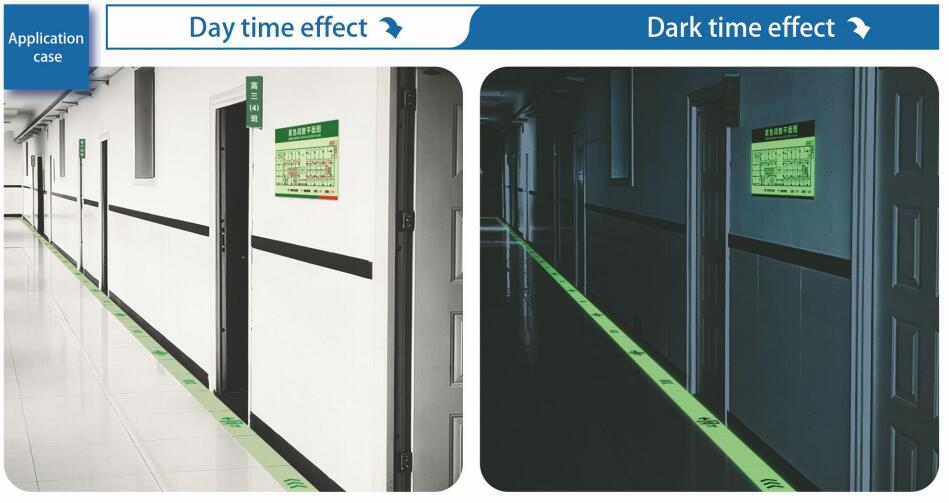
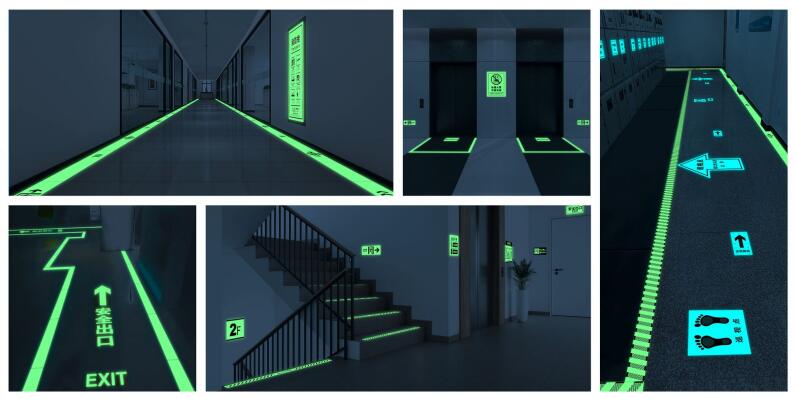
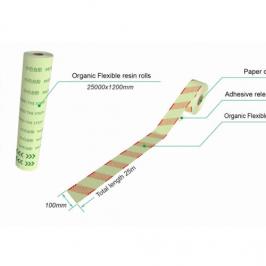
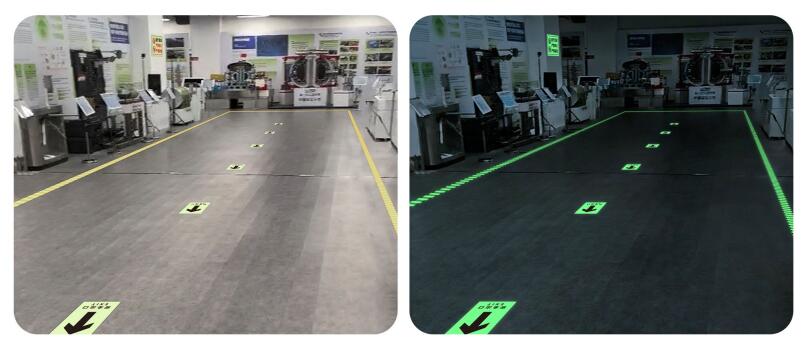
Organic self-luminous signs usually use resin, plastic or composite flexible materials as substrates, with added or compounded long-afterglow light-storing materials. Their advantages include light weight, flexible processing, cuttability and self-adhesive backing, making them suitable for positions such as walls, door frames, passages and complex corners.
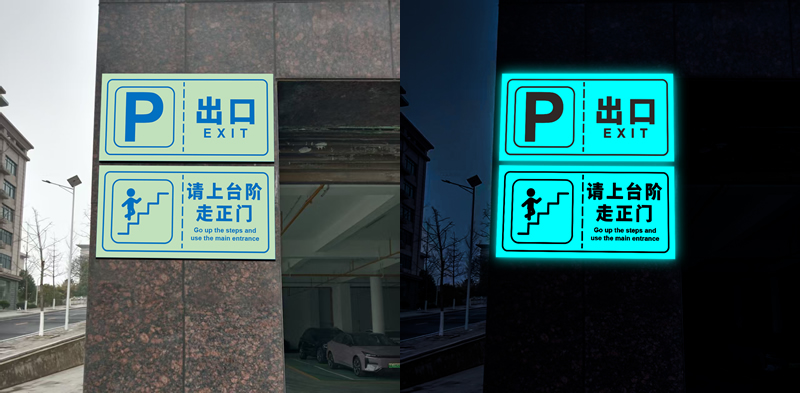
In terms of water resistance, some organic self-luminous products can meet the needs of daily scrubbing, short-term moisture or general moisture protection. However, water resistance varies greatly among different resin systems, surface coatings and adhesive structures. Long-term exposure to rain scouring, water immersion or high-humidity environments may cause problems such as adhesive layer aging, edge warping, surface yellowing or reduced interlayer bonding strength.
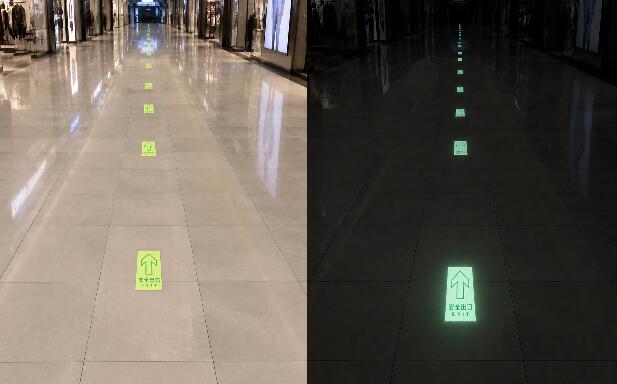
Long-term UV exposure and cold-heat cycles may also accelerate the aging of some organic materials. Therefore, ordinary organic self-luminous rolls and sign stickers are more suitable for environments such as shopping malls, hospitals, schools, office buildings, underground garages and indoor evacuation passages. If outdoor use is really necessary, products explicitly marked as outdoor weather-resistant type should be selected, and corresponding water resistance, UV resistance and service conditions should be verified.
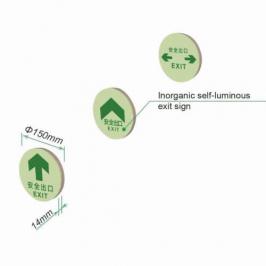
Inorganic self-luminous signs are usually made of inorganic mineral materials and light-storing materials through processes such as high-temperature sintering. With stable overall structure and outstanding water resistance, weather resistance and anti-aging performance, they are more suitable for long-term open-air environments.
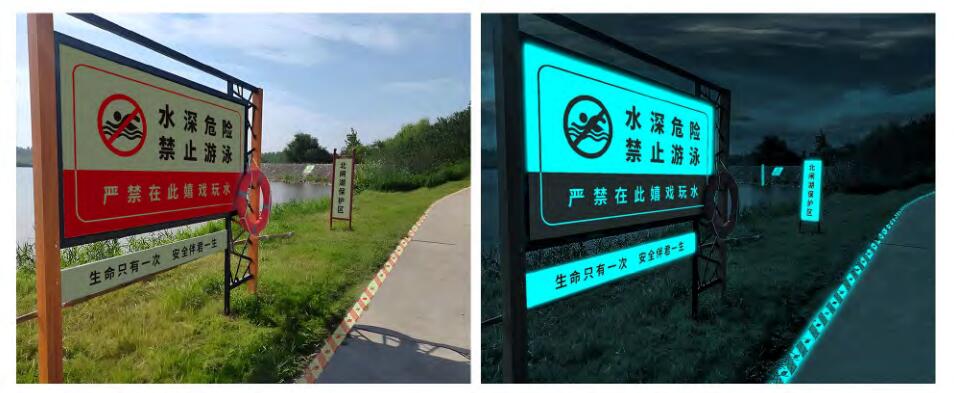
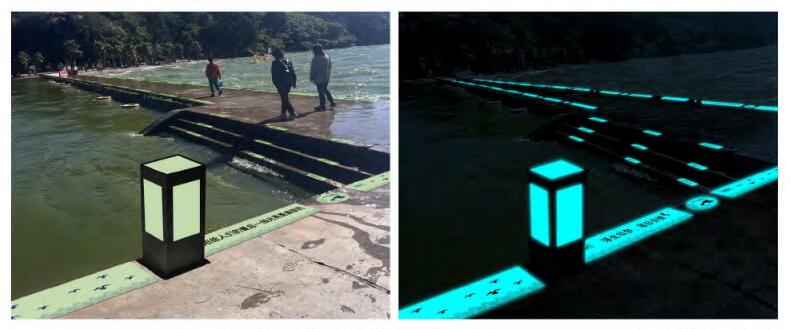
Compared with ordinary signs relying on surface coatings or film protection, inorganic sintered products generally maintain more stable dimensional and surface performance under long-term sun exposure, rain, high humidity and temperature change. For river dykes, reservoir banks, seawalls, mountain trails and municipal outdoor areas, they can reduce surface aging and frequent replacement caused by moisture and sun exposure.
In waterfront scenarios, inorganic self-luminous signs require no power supply lines or electronic components inside, so there is no risk of short circuit caused by water entering the internal circuit. When used in areas with possible short-term water immersion, the panels, fixtures, adhesive layers and surface conditions shall still be inspected after water recedes, and service can be resumed after confirming intactness.
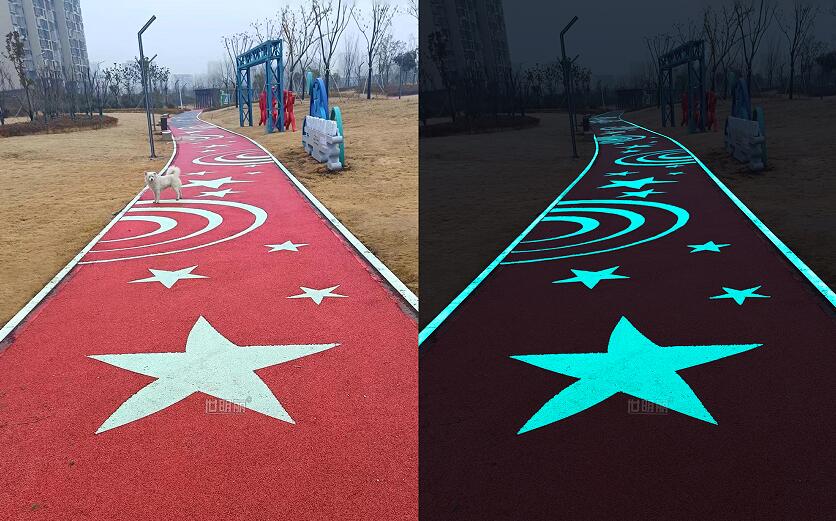
In addition, inorganic self-luminous signs can be designed into forms such as warning boards, floor marking tiles, guidance lines, water level indicators and step warnings, suitable for long-term open-air areas such as scenic trails, municipal roads, water conservancy dykes, coastal engineering and industrial & mining sites.
When selecting outdoor self-luminous signs, in addition to water resistance, comprehensive consideration should be given to UV resistance, salt spray resistance, wear resistance, impact resistance, installation firmness and on-site light-storing conditions.
Coastal and seawall areas should focus on salt spray and humid environments; reservoirs, rivers and dykes need to consider water immersion, sediment scouring and fixing structures; mountainous and scenic areas should pay attention to day-night temperature difference, rain and snow weather, and floor anti-slip performance. For floor-mounted products, the surface shall be flat and anti-slip to avoid obvious protrusions affecting passage.
For performance indicators such as water resistance grade, weather-resistant service life, afterglow brightness and continuous luminous duration, they shall be subject to test reports, technical parameters and actual service conditions of specific models, and cannot be judged suitable for outdoor use only by the word "luminous".
Whether self-luminous photoluminescent signs are afraid of water and can be installed outdoors fundamentally depends on product materials and manufacturing processes. Ordinary organic self-luminous products are light, flexible and easy to install, more suitable for indoor and sheltered environments; inorganic self-luminous products have more advantages in water resistance, weather resistance and anti-aging, more suitable for long-term open-air, waterfront and complex outdoor working conditions.
Globright recommends that project selection should not only compare initial price or luminous brightness, but make comprehensive judgment combined with application environment, installation method, maintenance conditions and expected service life. Selecting self-luminous materials matching actual working conditions can not only ensure nighttime visual prompting effect, but also reduce later maintenance and repeated replacement costs.