Tel: +86 139 0589 5606
E-mail:info@globri.com

Tel: +86 139 0589 5606
E-mail:info@globri.com
Fire incidents are usually accompanied by extreme conditions such as sudden power outages, burnt-out circuits and high-temperature scorching. Traditional powered emergency indicator lights rely heavily on circuit systems. Once circuits melt, circuit boards burn out or batteries fail under high temperature, they will break down collectively and completely lose their evacuation guidance function.
Globright self-luminous signs are non-combustible or flame-retardant products. They can operate normally in fire and high-temperature environments, and deliver autonomous luminescence for more than 10 hours. Ordinary luminous films and acrylic luminous panels are all combustible materials. They will melt, fail and support combustion under high temperature, and cannot function properly.
The core hazards at fire scenes are not only open flames, but also the dual impact of sustained high temperature and circuit paralysis — which is also the fatal shortcoming of traditional emergency facilities.
Traditional powered emergency lights have built-in circuit boards, batteries and wiring systems. When a fire breaks out, high temperature will quickly scorch lines, melt circuits and damage batteries. Even if the lamp appearance remains intact, it will fail completely and fail to provide any evacuation guidance.
Most low-priced ordinary luminous products on the market are made of plastic, film and ordinary resin, with extremely poor high-temperature resistance and flame retardancy. Exposed to high temperature in fires, they will quickly soften, shrink, melt and peel off. Not only do they completely lose luminous function, but they also produce dripping substances and support combustion, aggravating the spread of fire.
In fire environments with total power failure and high-temperature confinement, inorganic self-luminous signs — which require no electricity, withstand high temperatures and are non-combustible and non-melting — are the only emergency guidance facilities that can operate continuously.
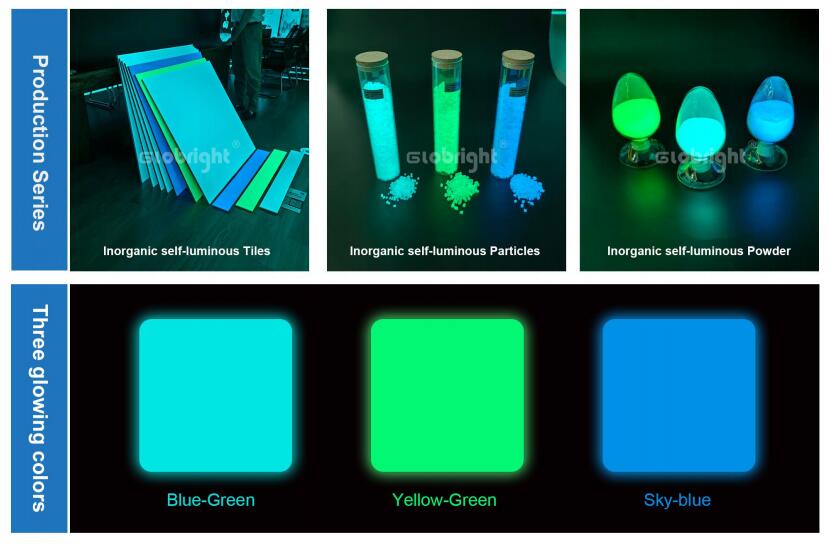
Globright inorganic self-luminous panels are made from multiple inorganic minerals through integral firing at temperatures of over 1000°C, forming a stone-like material with high-temperature resistance and non-combustible properties. Notably, higher temperatures further stimulate their brightness. The product adopts a pure physical light-storing luminescence principle, relying on the light-storing layer to complete an infinite cycle of light absorption, energy storage and light emission. No external power supply, battery, circuit or electronic component is required throughout the process.
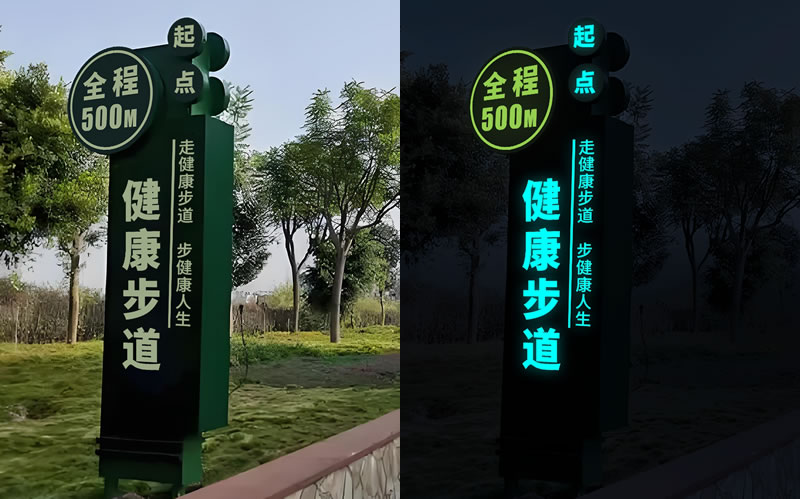
Globright organic self-luminous rolls are flexible materials made of high-molecular organic resin as the base material, compounded with long-acting light-storing self-luminous materials. They meet the Class B1 flame-retardant standard, self-extinguish within 10 seconds after leaving the fire source, and molten substances carbonize without dripping. They also operate on the physical light-storing luminescence principle, with no external power supply or electronic components at all.
Both are organic combustible materials. They produce molten drips when burning and easily cause secondary fire sources. They are not recommended for use as fire emergency signs.
In conclusion, whether self-luminous signs can work normally under high-temperature fire conditions depends not on the luminescence principle, but on material technology, flame retardancy and high-temperature resistance. Traditional powered emergency equipment is prone to complete failure in fires. With core advantages of passive luminescence, high-temperature resistance, non-combustibility and non-combustion support, engineering-grade self-luminous signs serve as the last line of safety guidance under extreme fire conditions.