Tel: +86 139 0589 5606
E-mail:info@globri.com

Tel: +86 139 0589 5606
E-mail:info@globri.com
Hospitals are high-occupancy special public buildings operating 24/7 with complex functional zones. Areas including inpatient wards, outpatient clinics, operating rooms, intensive care units (ICUs) and underground spaces must maintain normal medical order while meeting fire emergency requirements during fires, sudden power outages and low-illuminance nighttime conditions. Clear, continuous safety warnings and evacuation guidance serve as critical visual support for medical staff, patients and accompanying family members to locate safety exits, evacuation routes and fire-fighting facilities.
Globright organic self-luminous roll materials, engineered with long-duration photoluminescent light-storing technology and a flexible composite structure, deliver reliable nighttime visual guidance without continuous power supply. Featuring pressure-sensitive adhesive backing, flexible cuttability and customizable graphics, they adapt to diverse functional zones in hospitals and provide a flexible auxiliary signage solution for hospital fire safety management.
Unlike standard office buildings and commercial spaces, hospitals have vastly different evacuation needs for inpatients, people with reduced mobility, medical personnel and accompanying visitors. Traditional signage, which relies on external light sources, becomes completely ineffective during periods of low nighttime lighting or localized power outages caused by fire.
Some hardwired fire safety signs require dedicated circuit installation and run on mains or backup power. Over time, issues such as circuit aging, battery failure and inadequate maintenance can disrupt their functionality. For operational hospitals, adding hardwired signage involves construction work including grooving, wiring and drilling, which often disrupts medical services, patient rest and pedestrian flow.
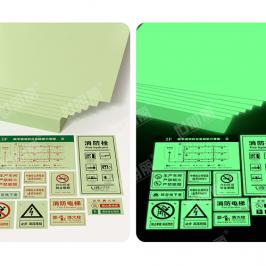
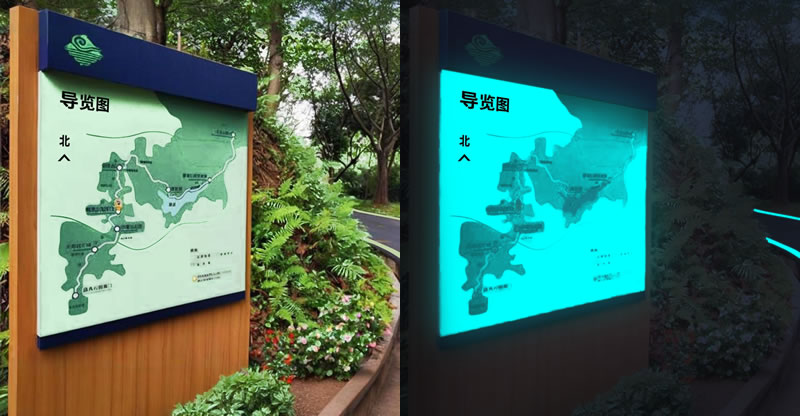
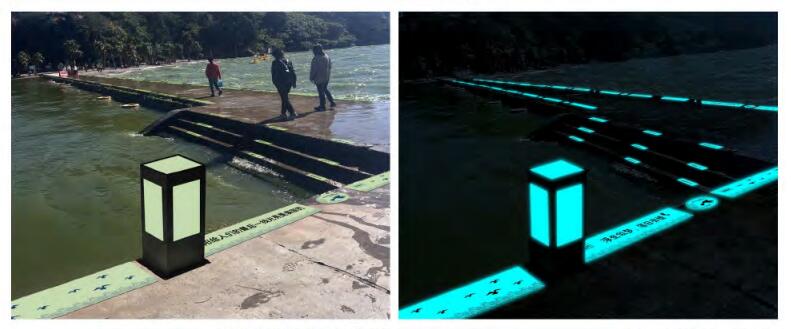
Globright organic self-luminous roll materials use a polymer resin substrate compounded with long-lasting photoluminescent light-storing material, creating a flexible signage medium with autonomous luminescent properties. The material absorbs and stores energy from ambient indoor light and daily lighting, then gradually releases visible light in dark environments. A single full charge delivers over 10 hours of continuous luminescence, with no external power supply or built-in batteries required. It serves as a reliable complement to traditional fire emergency signage in hospitals.
A wear-resistant protective layer on the surface withstands daily cleaning and regular foot traffic. In addition, the flexible material supports precision cutting, UV printing and custom graphics, and can be applied to flat walls, columns, door frames and irregular corners, enabling highly flexible signage deployment across complex hospital building layouts.
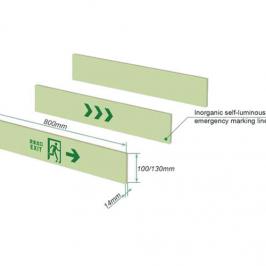
Inpatient corridors, nurse station perimeters, ward entrances and evacuation corridors are critical zones for daily pedestrian flow and emergency evacuation in hospitals. Organic self-luminous roll materials can be fabricated into evacuation direction arrows, auxiliary safety exit markers, continuous waist-height luminous guide strips and floor guidance markings, connecting scattered sign nodes into a cohesive visual evacuation route.
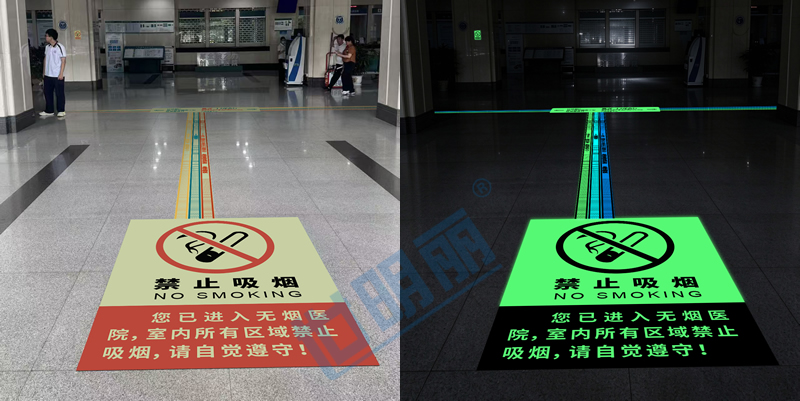
In practical application, self-luminous guide strips can be installed continuously along ward corridor walls, with directional prompts added at branch intersections, passage corners and near safety exits. The signage remains visible at night or during sudden power outages, providing visual reference for medical staff organizing patient transfers and accompanying personnel identifying travel directions, and reducing evacuation delays caused by route-finding difficulties.
Hospital stairwells, safety exits and evacuation corners are priority areas for fire emergency guidance. Organic self-luminous roll materials can be processed into auxiliary safety exit signs, stair tread warning strips, direction arrows and door frame guide markers. Combined deployment at multiple positions improves recognizability of key nodes.
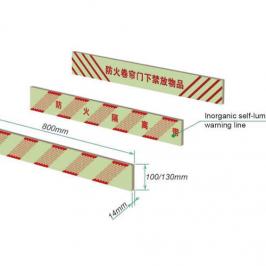
Self-luminous warning strips installed on stair tread edges help users identify step contours and elevation changes. Self-luminous directional markers beside safety exit doors assist occupants in locating exits in low-light conditions. These facilities work in synergy with existing hospital emergency lighting, fire evacuation signs and handrails to further strengthen emergency visual prompts in stair and exit zones.
Operating rooms, ICUs and associated medical corridors undertake critical medical treatment and patient transfer functions, with special requirements for traffic order, environmental management and emergency organization. For these zones, self-luminous directional signs and safety prompts can be installed on suitable peripheral passages, connecting corridors and transfer routes in alignment with the hospital’s established fire emergency plan, providing route reference for medical staff during nighttime duty, emergency transfers and periods of insufficient local lighting. Signage deployment in these areas shall also account for medical equipment operation, cleanliness management and normal diagnosis requirements to avoid disrupting medical work.
Fire-fighting facilities in hospitals such as fire hydrants, fire extinguishers, manual alarm buttons and smoke control and exhaust systems require clear, eye-catching position markers and operation prompts. Using organic self-luminous roll materials, facility names, direction arrows and auxiliary positioning markers can be applied to equipment cabinets and surrounding walls, helping on-site personnel quickly locate fire-fighting facilities in low-light or power outage conditions.
For pharmacies, power distribution rooms, equipment rooms and other key controlled zones, self-luminous warning text, area boundaries and no-entry prompts can be installed based on on-site risks to strengthen risk identification capability at night and in emergency states. Signage placement shall not obstruct the opening of fire equipment, operation of alarm buttons or equipment maintenance access.
Hospital patient populations include wheelchair users, people with reduced mobility and patients requiring bed transfer. Therefore, fire emergency signage design shall not only consider able-bodied pedestrians, but also be deployed in a targeted manner aligned with hospital barrier-free passages, refuge areas and patient transfer arrangements.
Self-luminous direction arrows, auxiliary guide strips and zone prompts can be installed at relevant passages and key nodes to provide visual reference for medical and accompanying staff to identify scheduled evacuation routes. Reasonable integration of standard evacuation routes and special group transfer pathways helps improve the hospital’s multi-level emergency visual guidance system.
Signs made from organic self-luminous roll materials require no grooving or wiring for the signage itself, and can be cut and applied to different mounting surfaces. For operational hospitals, phased and time-scheduled construction can be arranged according to departmental operation plans, with installation prioritized during low-traffic periods to minimize impact on patient rest, outpatient services and pedestrian flow.
Before installation, dust, oil stains and moisture on wall, floor or door surfaces shall be removed to ensure a flat, dry base layer. Product and adhesive variants shall be selected to match the hospital’s daily disinfection and cleaning protocols. For floor applications, attention shall also be paid to wear resistance, slip resistance and adhesion strength to prevent edge lifting that could impede bed, wheelchair and pedestrian traffic.
Compared with signage requiring supporting electrical circuits, flexible self-luminous roll materials eliminate portions of grooving, wiring and equipment installation work, making them well-suited for fire sign supplementation and partial retrofitting in existing hospital buildings.
Hospitals have a large number of widely distributed fire emergency signs, and later management must balance inspection efficiency and facility reliability. Organic self-luminous roll materials require no dedicated power circuits or batteries, eliminating maintenance tasks such as battery replacement, circuit inspection and ongoing power consumption.
Daily management mainly includes surface cleaning of signs, adhesion firmness inspection, graphic integrity checks and nighttime luminous effect verification. Signs showing wear, adhesive failure, blurred graphics or degraded luminous performance shall be maintained or replaced promptly to ensure continuous performance.
The application of organic self-luminous roll materials is not limited to individual safety exit signs. They can be deployed in combination via wall-mounted guide strips, floor guidance, stair warnings, fire facility positioning and risk prompts in key areas.
Connecting key nodes such as wards, corridors, stairs, safety exits and fire-fighting facilities forms an auxiliary fire visual guidance network covering the hospital’s main functional zones, which continues to function during normal operation, nighttime duty and sudden power outages.
Note that self-luminous roll materials are auxiliary fire safety signage materials and cannot replace legally required fire emergency lighting, evacuation indication systems and other necessary safety facilities in hospitals. Actual project design shall be carried out in combination with on-site lighting conditions, product performance test reports and hospital fire emergency plans.
With the advantages of passive light storage, long-duration luminescence, flexible fabrication and adhesive installation, organic self-luminous roll materials provide a more flexible application option for hospital fire emergency signage construction and existing building retrofitting. Reasonable deployment in ward corridors, safety exits, stairwells, fire-fighting facilities, key medical zones and barrier-free passages further improves the hospital’s continuous, multi-level emergency visual guidance system. Reducing long-term management burden by simplifying maintenance procedures represents the core application value of organic self-luminous roll materials in 24/7 hospital operating environments.