Tel: +86 139 0589 5606
E-mail:info@globri.com

Tel: +86 139 0589 5606
E-mail:info@globri.com
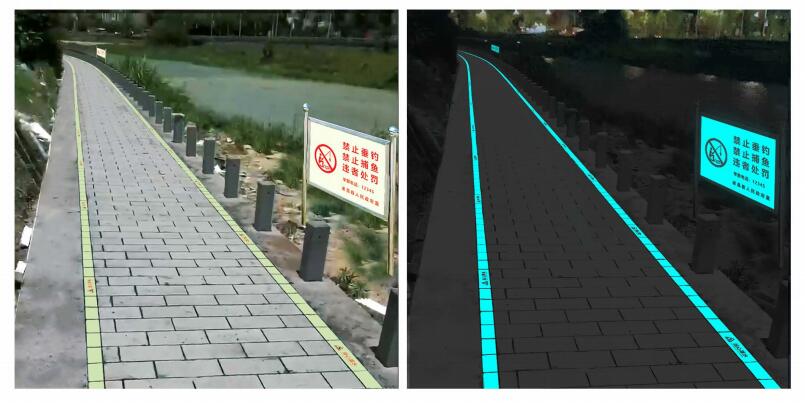
In high-risk areas such as pedestrian ramps, tunnel entrances and exits, scenic trails and waterfront steps, slippery ground and poor nighttime visibility are two coexisting major safety hazards. Traditional anti-slip tiles only provide anti-slip performance in daytime with no nighttime emergency guidance function at all. Inorganic self-luminous strip-insert anti-slip floor tiles combine anti-slip safety with nighttime safety guidance. Made from multiple inorganic minerals and integrally sintered at 1000°C high temperature, they adopt an interval design of anti-slip strips and crystalline glaze layers on the tile surface, achieving the dual effects of structural anti-slip and passive long-lasting luminescence. They are the preferred pavement solution that balances safety and economy for outdoor high-risk areas.
Inorganic self-luminous strip-insert anti-slip floor tiles are special engineering pavement materials that integrate structural anti-slip and emergency luminous functions. Taking multiple inorganic minerals as core raw materials and integrally sintered at 1000°C high temperature, the raised inserts on the tile surface serve as anti-slip structures, while the recessed crystalline glaze layer features self-cleaning function.
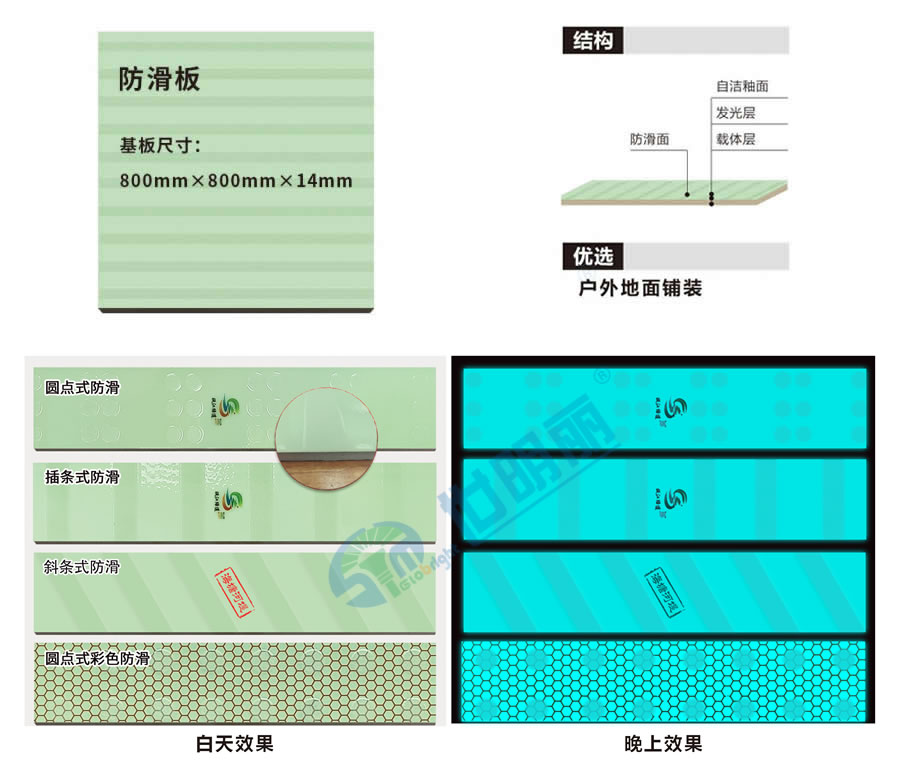
In terms of functional essence, they achieve long-lasting anti-slip through raised physical structures, and realize active luminescence in dark environments through the inorganic light-storing luminous layer. One set of pavement solves two major safety problems: slipping on wet ground and nighttime evacuation guidance. The all-inorganic sintered structure endows them with Class A non-combustibility, zero water absorption, freeze-thaw resistance, weather resistance and anti-aging properties, adapting to various complex outdoor working conditions such as open-air, waterfront and high-humidity environments.
Many people mistakenly think that the anti-slip inserts are pasted on the tile surface in post-processing, which is not the case. Formal inorganic self-luminous strip-insert anti-slip floor tiles adopt the integral sintering process. The substrate, luminous layer, crystalline glaze layer and anti-slip inserts are fused into a complete whole with no splicing seams or adhesive layers, and the structural strength is completely uniform. It fundamentally eliminates the problems of peeling, edge warping and delamination from the manufacturing process.
The strip-insert design forms an interval concave-convex structure. Rainwater and sediment can be quickly discharged from the recessed parts, and the raised inserts always maintain dry contact with the soles of feet, delivering more stable anti-slip performance in rainy days. Meanwhile, the raised structure increases the sense of resistance underfoot. In high-humidity and slippery areas such as ramps and waterfronts, the anti-slip stability and reliability far exceed ordinary full-surface matte anti-slip tiles.
For full-surface anti-slip tiles, stains and sediment will evenly adhere to the surface, which easily blocks the light absorption of the underlying luminous layer, resulting in weakened or no luminous effect. The concave parts of strip-insert tiles are crystalline glaze layers. In outdoor scenarios, rain scouring realizes self-cleaning, and sediment and stains are not easy to accumulate. Thus, they will not block the light absorption of the underlying luminous layer, and can emit light normally at night.
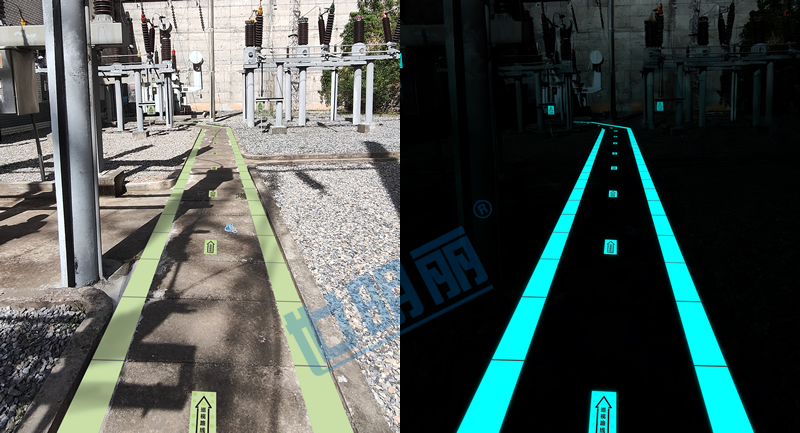
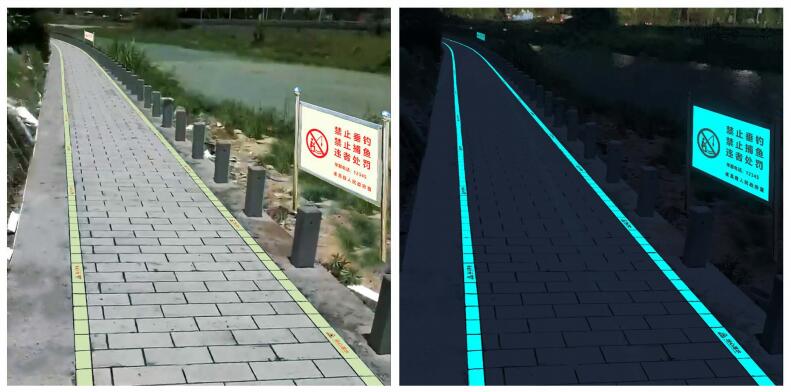
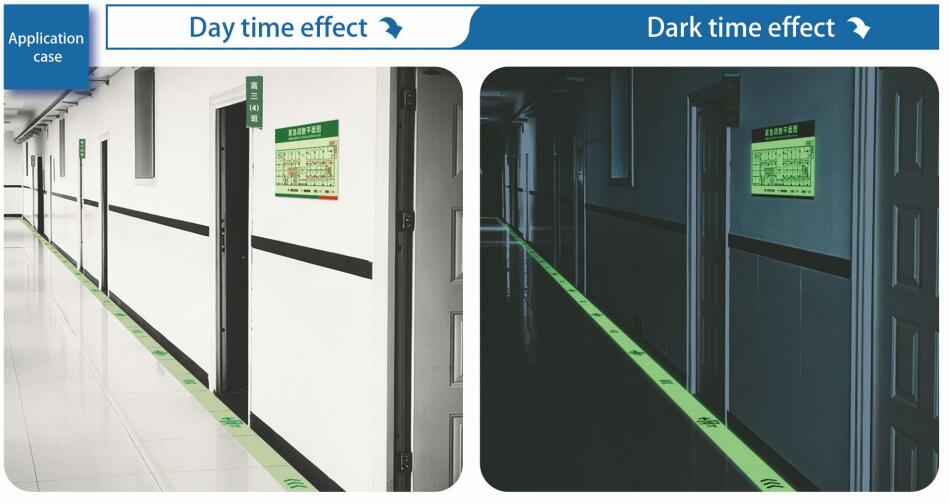
The core of emergency guidance is sense of direction and recognizability. Self-luminous floor tiles can be continuously laid along the direction of travel, forming a continuous luminous guide belt with clear directionality. They can clearly guide the direction of travel in nighttime environments, with both warning and guiding functions.
Self-luminous anti-slip floor tiles themselves are made of high-hardness inorganic sintered materials, with a wear grade completely consistent with the tile substrate. They also feature corrosion resistance, anti-aging performance and water immersion resistance. After long-term trampling, the luminous performance attenuates extremely slowly, and the effective outdoor luminous service life can reach more than 15 years.
All in all, inorganic self-luminous strip-insert anti-slip floor tiles are the optimal engineering solution under the dual demands of anti-slip safety and luminous guidance. The strip-insert design is by no means a simplification, but an optimal choice balanced in multiple dimensions: anti-slip performance, luminous guidance effect, service life, engineering cost and operation difficulty. Coupled with the characteristics of no power connection required and maintenance-free operation, it makes itself a highly cost-effective safety pavement material for ramps, slippery areas and nighttime high-risk zones.